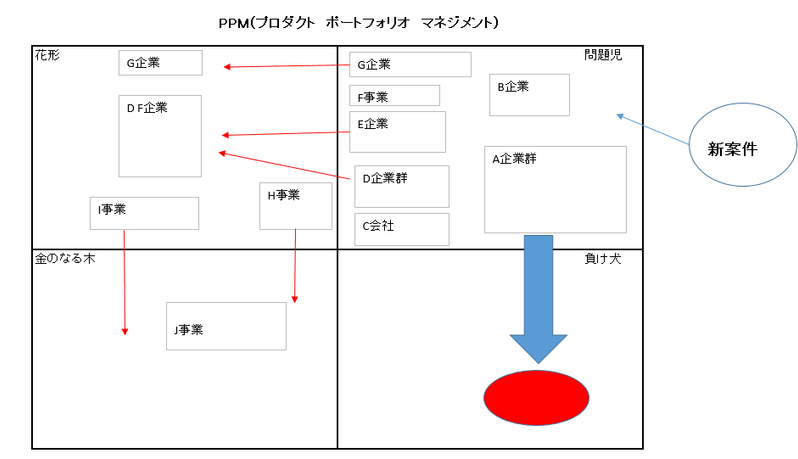
縦軸も横軸も矢印の通りです。
動的PPMを使い始めて実感しているのは、個人の活動でも「組織は戦略に従う」がそのまま当てはまるということです。 戦略が明確になると、新しく入ってくる案件をまず第3象限の「問題児」に置き、どう花形商品へ育てるかを検討します。これが戦略であり、そこから落とし込む具体行動が戦術になっていきます。
さらに、案件が伸び悩んだときは「問題児に残すのか」「負け犬にするのか」を判断します。 この循環があることで、意思決定がブレず、行動が戦略に沿っていきます。そして気づいたのは、市場占有率(横軸)も市場成長率(縦軸)も、矢印の通りに動くということです。 動的PPMは、個人でも十分に“戦略OS”として機能するのです。
Structure follows strategy!
Both the vertical and horizontal axes move in the direction of the arrows.
Since I began using Dynamic PPM, I have realized that the principle “structure follows strategy” applies just as well to individual activities. Once the strategy is clear, I place any new project into the third quadrant—the “Question Mark” (or “Problem Child”)—and consider how to nurture it into a “Star” product. This constitutes the strategy, while the specific actions derived from it become the tactics.
Furthermore, if a project’s growth stalls, I must decide whether to keep it in the “Question Mark” category or relegate it to the “Dog” category. This cycle ensures that decision-making remains consistent and actions stay aligned with the strategy. I also discovered that both market share (horizontal axis) and market growth rate (vertical axis) shift in the direction of the arrows. Dynamic PPM functions effectively as a “strategic operating system” even for an individual.